
How Does the Brainwave Card Trick Work? (Revealed)
A freely named card is the only face-up card in the deck, and it has a different coloured back. The rough-and-smooth secret explained.
A spectator names any card, completely freely. The magician opens a card box, spreads the deck face down, and one single card is face up among all the others. It is the named card. Then comes the impossible kicker: that card has a different coloured back from every other card in the deck. So how does the Brainwave card trick work? The answer is a cleverly built trick deck, in which every card is secretly paired with another, and a special coating lets the magician split the pairs at will.
What Is the Brainwave Card Trick?
The Brainwave deck is a classic trick deck, designed by Vincenzo Di Fatta, that turns a freely named card into a miracle of prediction. Unlike a trick where the spectator picks a card from a spread, in Brainwave the spectator only names a card. They never touch the deck until the reveal. That hands-off structure is what makes the effect feel like genuine mind reading rather than sleight of hand.
The routine runs in three beats. First, the free choice: any of the 52 cards can be named. Second, the reversal: the deck is spread and exactly one card lies face up, and it is the named card. Third, the colour change: the named card is turned over to show a back of a different colour from the rest of the deck, as if the magician knew the choice in advance and marked that card long before the show began.
The Brainwave Deck Secret: Rough and Smooth Pairs
The Brainwave deck secret is a principle called rough and smooth. The deck contains 52 cards, but they are assembled as 26 face-to-face pairs. Half the cards have red backs and half have blue backs, arranged so that each pair consists of one red-backed card and one blue-backed card stuck face to face. The faces of each pair are treated with roughing fluid, a coating that makes two treated faces cling lightly together, like two sheets of fine sandpaper pressed flat.
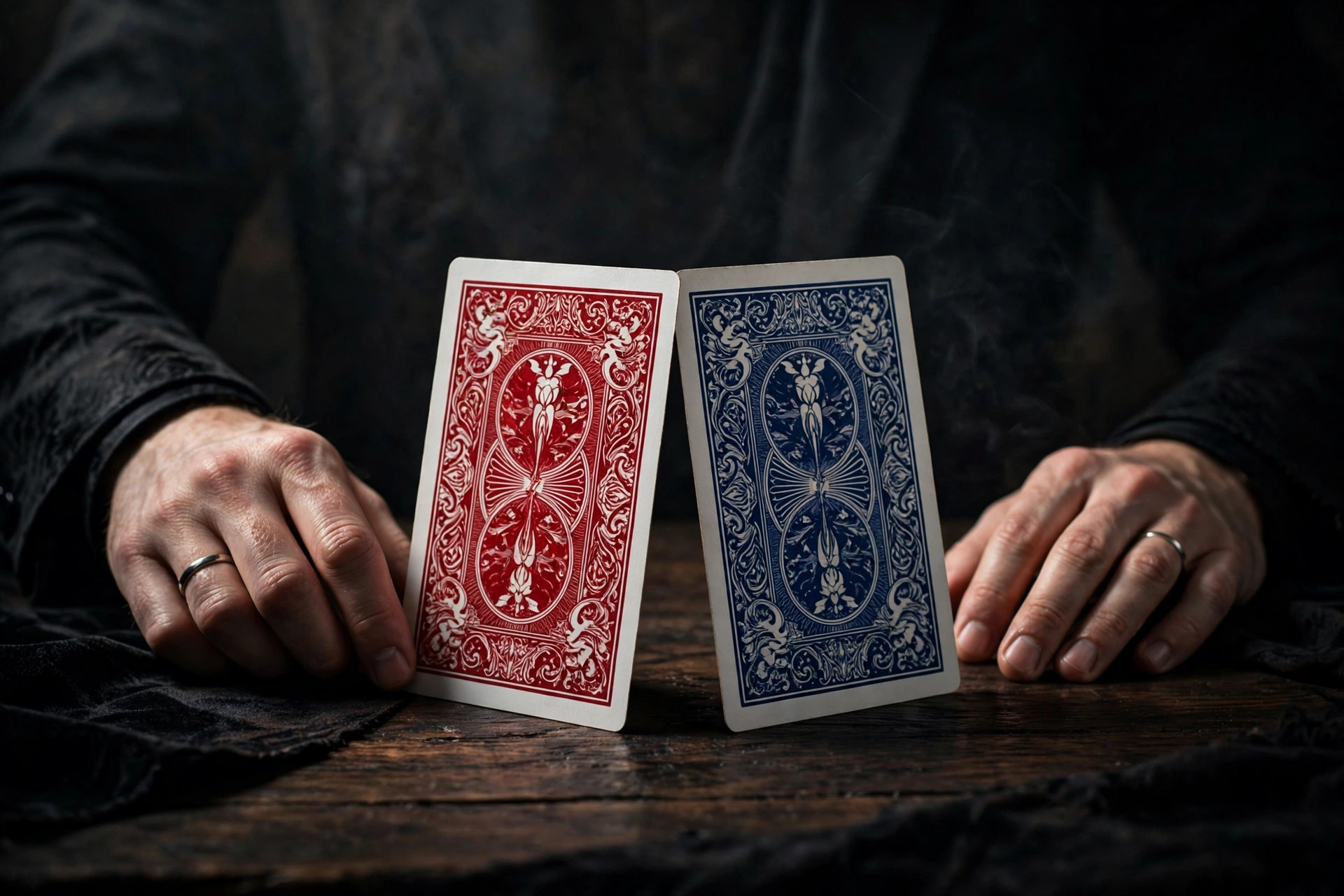
The pairs are arranged in a fixed order, so that every possible named card has a partner. For example, a red-backed Ace of Spades is paired face to face with a blue-backed King of Hearts, and so on through the deck. The deck is kept in its box with the backs matching the colour of the box facing up, so the magician always knows which side to spread from. When the spectator names a card, the magician knows exactly which pair contains it and which way to handle the spread.
This is the same family of secret as the invisible deck trick, where a reversed card appears in a face-down deck. Brainwave improves on that classic by adding the different-coloured back as a second, stronger climax, and by removing the need for the spectator to handle the cards at all.
How the Brainwave Card Trick Works Step by Step
The Brainwave deck trick tutorial, in outline, is a handling routine rather than a sleight. The magician removes the deck from its box and holds it face down. Because the cards cling in pairs, the deck can be spread or fanned and it will look like 52 separate cards, when in fact the spectator is seeing the backs of 26 pairs.
- The named card is located: Knowing the fixed pair order, the magician spreads through the deck to the pair containing the named card, keeping the pairs together with light pressure.
- The pair is split: With a slight twist of the fingers, the rough-and-smooth bond is broken at exactly that pair, and the named card is turned face up while its partner stays face down.
- The spread continues: The rest of the deck is spread normally, so the audience sees one face-up card among 51 face-down cards, and it is their freely named card.
- The colour kicker: The named card is lifted and turned over, revealing a back of the opposite colour from every other card in the spread.
Why does the colour change convince the audience so completely? Because a reversed card could, in theory, have been flipped during the performance. A different-coloured back cannot be explained that way. The audience reasons, correctly, that the card must have been different from the start, and wrongly concludes that the magician predicted the choice. That logical trap is the real engine of the trick, and it is why Brainwave remains a professional favourite decades after its release, alongside classics like the ambitious card routine.
Brainwave vs Invisible Deck: Which Trick Deck Is Better?
The Brainwave vs Invisible Deck debate comes down to handling and climax. The Invisible Deck is simpler to reset and can be handed out more freely, but its reveal is a single beat: the reversed card. Brainwave demands careful deck order and a trick deck that must never be examined, but it delivers a two-beat climax, reversal plus colour change, that hits harder for a lay audience.
There is also a practical difference. In the Invisible Deck, the spectator selects a card by handling the deck, which gives the routine a tactile, participatory feel. In Brainwave, the spectator only thinks of a card, which makes the effect feel more like mentalism. Performers who want a mind-reading frame choose Brainwave; performers who want a hands-on card trick choose the Invisible Deck. Many professionals carry both, using Brainwave as the closer, as in today's other new article on how the floating cup trick works, where the simplest method also produces the strongest reaction.
Performing Tips: Selling the Prediction
The biggest performing mistake with Brainwave is rushing the reveal. Let the spectator repeat their named card out loud, let the audience register that the choice was free, and only then spread the deck. The pause builds the impossibility before the method even matters. When the face-up card appears, do not touch it immediately: let the spectator point to it and confirm it themselves.
Never let the deck be examined afterwards. The pairs, the roughing fluid, and the two-coloured backs are all discoverable on inspection. End cleanly: pocket the deck or return it to its box as you move on to the next effect, while the audience is still reacting to the colour change. A trick deck that leaves the table unexamined stays a miracle; one that gets shuffled by a curious spectator becomes a puzzle with an obvious answer.
Frequently Asked Questions
How does the Brainwave card trick work?
The Brainwave deck holds 52 cards as 26 face-to-face pairs treated with roughing fluid, so they cling together. The magician splits the pair containing the named card, revealing it face up with a different coloured back.
Can you do the Brainwave trick with a normal deck?
No. The effect needs the paired, rough-and-smooth trick deck with red and blue backs. A normal deck cannot produce the different-coloured back climax.
Is the Brainwave deck the same as the Invisible Deck?
They are related but different. Both reveal a named card reversed in a face-down deck, but Brainwave adds a different-coloured back, and the spectator never handles the deck.
Who invented the Brainwave deck?
The Brainwave deck was designed by Vincenzo Di Fatta and became popular as a self-working mentalism effect that needs no sleight of hand, only careful handling.
Why does the named card have a different coloured back?
Each pair joins one red-backed card to one blue-backed card. When the pair is split to reveal the named card, its back is the opposite colour from the backs facing the audience.
Julian Vance
Head of Sleight Analysis & Magic Historian
Former magic consultant for West End theatrical productions with over 18 years of sleight-of-hand performance experience.
Frequently Asked Questions
Continue Reading
How Does the Ambitious Card Trick Work? (Revealed)
Ever wondered how a signed card keeps rising to the top no matter where it is inserted? The full breakdown of the moves, angles and psychology.
10 Easy Card Tricks for Beginners (No Sleight of Hand)
You do not need years of knuckle-busting sleight of hand to astonish your friends. Ten self-working card tricks you can perform right away.
Loved This Breakdown? Learn to Perform It.
25 Self-Working Card Tricks Anyone Can Do - the ebook that turns you from spectator to magician. No sleight of hand needed.
Get the Ebook - $12