
How Does the Floating Card Trick Work?
A card rises from an open palm and hangs in midair. The secret is thinner than a hair — and older than you think.
The magician holds out an open palm. A single playing card rests on it, face up, both sides shown moments before. Then, with no visible support and no hand touching it, the floating card trick begins: the card rises slowly into the air, hovers a few inches above the hand, drifts sideways, and settles back down as if gravity had briefly changed its mind. There are no wires in view, no magnets on display, and nothing hidden under the sleeve that the audience can spot. So how does the floating card trick work?
The Secret: Invisible Thread and Magician’s Wax
The classic floating card trick revealed in almost every professional performance relies on one beautifully simple idea: a thread so fine that the human eye cannot resolve it at arm’s length. This is the invisible thread magic trick at its purest. A length of ultra-fine thread — often a single filament stripped from nylon or polyester — is anchored behind the magician’s ear or at the collar with a dab of tape, run down past the face, and attached to the centre of the card with a pea-sized ball of magician’s wax.
The wax is the unsung hero of the effect. It grips firmly enough to carry the weight of a playing card, yet peels away cleanly when the magician wants the card examined. Before the performance, the wax sits hidden on the magician’s thumbnail. During a natural gesture — taking the card back from a spectator, for example — the wax transfers to the card in a fraction of a second. Nobody sees the load, because nobody is looking for it.
Once attached, the thread does all the lifting. Tiny movements of the head and hands change the thread’s tension, and the card rises, falls, and spins in response. The magician’s hands frame the card rather than holding it, which is exactly why the audience concludes that nothing is holding it at all.
How to Make a Card Float With the Hummer Card
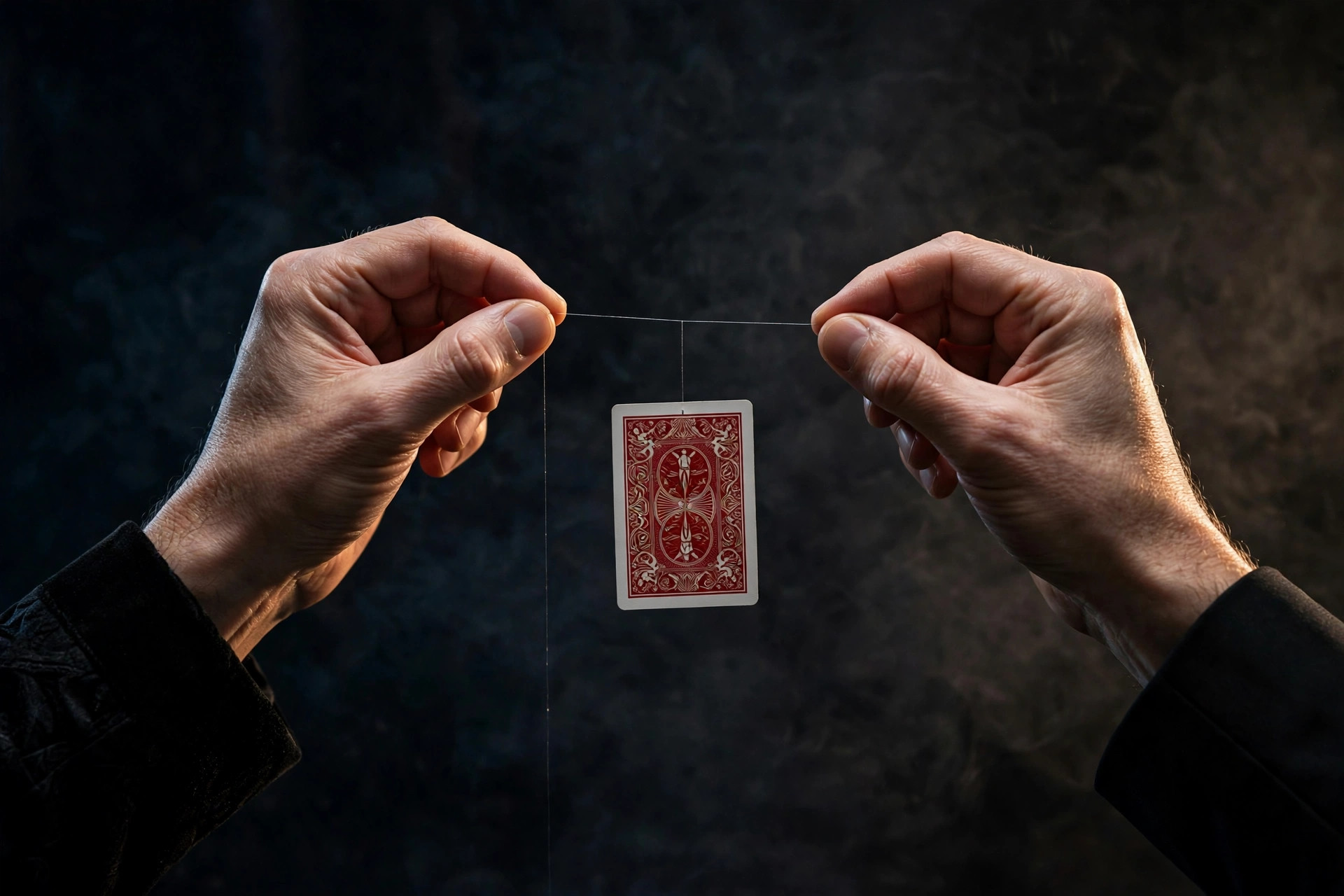
For beginners, the easiest route into this effect is the Hummer card trick, named after its inventor, Bob Hummer. The Hummer Flying Card kit, still sold today, packages the whole method: pre-rigged thread, wax, and clear instructions. The setup anchors one end of the thread to the performer’s body and the other to the card, and the performer learns to steer the card by moving their hands apart, together, and in small circles.
The Hummer method teaches the single most important lesson of levitation magic: the card must never move faster than the magician’s breathing. A slow, floating rise reads as impossible; a jerky one reads as a string. Professionals rehearse in front of a mirror with a plain background, because a dark, uncluttered backdrop is what makes the thread truly disappear. Bright, busy backgrounds and harsh side light are the thread’s worst enemies.
Modern professionals often upgrade the basic rig to a motorised reel, such as the Tarantula system, which winds and unwinds thread automatically. The principle is identical — invisible support plus controlled tension — but the reel allows longer floats, wider travel, and even cards that fly from one hand to the other.
The No-Thread Method: Floating a Card With Your Hands Alone
Not every floating card uses thread. If you have ever wondered how to float a card without thread, the answer is a clever piece of finger engineering. In this version, the magician secretly sticks a thin strip cut from a second, matching card to the back of the floating card with double-sided tape. The strip is trimmed so its pattern blends into the card back design.
Laid face up in the palm with the strip running between the fingers, the card looks completely ordinary. As the magician slowly closes their fingers together, the strip is pinched and bowed upward, pushing the card up off the palm. Spread the fingers, and the card sinks back down. The float is small — only an inch or two — but performed inches from a spectator’s eyes, it is startlingly convincing, and the card can be turned over at the end to show an apparently ungimmicked back.
A third family of methods uses a fine wire spring and a hidden magnet, famously used in televised card levitations where the card hovers beside the deck itself. The spring extends silently, the magnet holds it, and the card appears to float free of everything. Each method trades range for reliability, which is why working magicians choose the version that fits the room they are in.
Why Your Eyes Believe the Float
The levitating card trick works because your visual system is built to track objects, not the empty space around them. A thread thinner than a human hair, seen against a dark background from several feet away, falls below the resolution limit of the eye — especially when the magician keeps your attention on the card’s face, the slow rise, and the story being told. Misdirection is not about looking away; it is about looking exactly where the magician wants you to look.
Lighting completes the deception. A single soft light from the front washes out the thread, while the magician’s dark clothing absorbs stray reflections. That is why the floating card is a parlour and stage favourite rather than a brightly lit street effect: control the light, and you control what can be seen.
If levitation fascinates you, compare this close-up method with the stage-scale version in our floating bill levitation, or study the handcraft behind the ambitious card routine. For the pocket-sized vanish that uses the same wax-and-thread thinking, read how magicians make a coin disappear, or start with how the ambitious card trick works.
Frequently Asked Questions
Is the floating card trick real levitation?
No. Every version uses a hidden support — invisible thread, a gimmicked card strip, a wire spring, or a motorised reel. The skill lies in making the support undetectable, not in defying physics.
Can beginners learn how to make a card float?
Yes. The Hummer Flying Card kit is designed for beginners and needs no sleight of hand, only practice controlling thread tension smoothly. Most learners get a convincing float within a few days.
What is invisible thread made of?
Usually a single ultra-fine nylon or polyester filament. It is strong enough to carry a playing card but thin enough to be invisible against a dark background at normal performance distance.
Can the floating card be examined afterwards?
In the thread version, yes, with a little handling: the magician detaches the wax and hands the card out. In the no-thread strip version, the card can be shown back and front, since the strip blends into the card back pattern.
Why does the card sometimes spin while it floats?
Spinning comes from anchoring the thread slightly off-centre. The uneven balance lets the magician add gentle rotation by changing hand positions, which makes the float look even less supported.
Julian Vance
Head of Sleight Analysis & Magic Historian
Former magic consultant for West End theatrical productions with over 18 years of sleight-of-hand performance experience.
Frequently Asked Questions
Continue Reading
How Does the Ambitious Card Trick Work? (Revealed)
Ever wondered how a signed card keeps rising to the top no matter where it is inserted? The full breakdown of the moves, angles and psychology.
10 Easy Card Tricks for Beginners (No Sleight of Hand)
You do not need years of knuckle-busting sleight of hand to astonish your friends. Ten self-working card tricks you can perform right away.
Loved This Breakdown? Learn to Perform It.
25 Self-Working Card Tricks Anyone Can Do - the ebook that turns you from spectator to magician. No sleight of hand needed.
Get the Ebook - $12