
How Does the Sponge Ball Trick Work?
The close-up classic dissected: compressibility, the false transfer, the multiplication, and the routine structure that turns two red balls into pure astonishment.
Ask working close-up magicians which trick gets the loudest gasp from the smallest prop, and one answer keeps winning: the sponge ball magic trick. A red sponge ball appears from nowhere, vanishes, reappears, splits into two, jumps from hand to hand, and finishes by growing into a giant ball nobody saw coming. There are no electronics, no threads, and no gimmicked props doing the heavy lifting. The secret is a humble piece of foam combined with two of the oldest tools in magic: a false transfer and the human brain\u2019s habit of seeing what it expects. Here is exactly how the sponge ball trick works, and why it fools even skeptics who already know how magic works.
The Core Secret: Why Sponge Balls Vanish So Easily
The entire trick rests on one physical fact: a sponge ball compresses to a fraction of its size. Squeeze a two-inch sponge ball and it flattens into a disc small enough to hide behind two fingers, in a curled palm, or under the thumb. Unlike a coin or a ring, a compressed sponge ball has no hard edges to betray it. When the magician\u2019s hand looks empty, relaxed, and natural, it often is not empty at all \u2014 it is holding a ball that has been squeezed flat.
This is why sponge balls are the ideal first prop for beginners. The classic beginner\u2019s guide advice of starting with one polished trick applies perfectly here: easy card tricks for beginners teach hand discipline, but sponge balls teach something harder \u2014 how to look innocent while secretly loaded. The bright red color is no accident either: against skin, a red ball reads instantly at a distance, so every vanish and reappearance registers with the whole audience.
The False Transfer: How the Sponge Ball Vanish Works
Every sponge ball routine opens the same way: the magician shows a red ball in the left hand, closes the right hand around it, and the ball is gone. The move is called a false transfer, and it is the single most important sleight in close-up magic. The right hand appears to take the ball \u2014 but the fingers of the left hand secretly retain it, compressed into a flat palm or finger clip, while the right hand closes on empty air.
Why doesn\u2019t the audience catch it? Because attention follows motion. The right hand is the moving, closing, \u201cactive\u201d hand, so every eye tracks it. The left hand falls still and relaxed, which the brain reads as \u201cnothing to see here.\u201d The same psychology powers the French drop coin vanish, where a coin appears to be taken by one hand while staying in the other. Timing sells the illusion: the transfer happens at natural speed, with no suspicious pauses, and the magician immediately looks at the empty-looking hand, directing the audience\u2019s gaze exactly where the trick isn\u2019t.
From there the vanish blooms into variations: the ball reappears in the other hand, is \u201cpulled\u201d from a spectator\u2019s ear, or is crushed into nothing between the palms \u2014 each time, a compressed ball hides exactly where the audience has already decided not to look.
How Sponge Balls Multiply in Your Hand
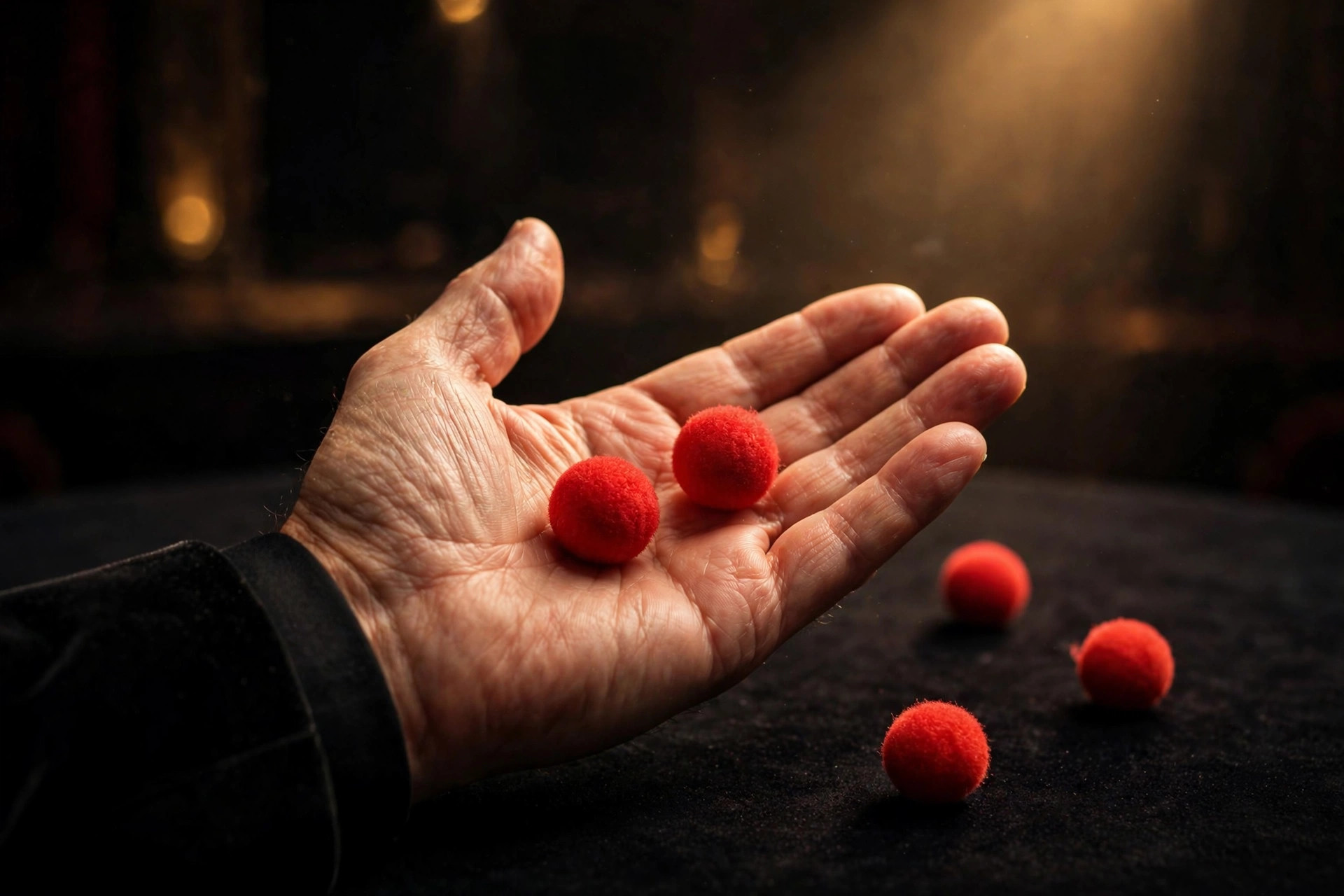
The multiplication is the moment that breaks brains. The magician holds one ball, rubs it between both hands, and opens to reveal two. The method is gloriously simple: there were two balls all along. One was displayed openly; the other was secretly compressed and hidden \u2014 palmed in the dominant hand from the very start. When the hands come together to \u201crub\u201d the ball, the hidden ball is quietly added to the visible one.
The illusion is airtight because the audience counts what they see, not what is possible. They watched one ball go into the rubbing motion, so two balls coming out reads as creation, not addition. Professionals chain this: two become three, three travel between hands, and every \u201cmiracle\u201d is just another secretly loaded ball joining the visible ones. Our full step-by-step breakdown of the sponge balls multiplication routine shows the exact loading sequence used on stage.
Building a Sponge Ball Routine That Fools Skeptics
Random tricks don\u2019t fool skeptics \u2014 structured routines do. A professional sponge routine follows a rising ladder of impossibility, and it is worth learning in this order:
- The appearance: a ball materializes from an empty hand. The audience learns the object.
- The vanish: the ball disappears using the false transfer. The audience learns the stakes.
- The multiplication: one ball becomes two, then three. The audience\u2019s logic breaks.
- The travel: a ball placed in a spectator\u2019s own closed fist jumps back to the magician\u2019s hand \u2014 the moment they remember forever.
- The final load: a jumbo ball appears from nowhere, proving everything they assumed was wrong.
Notice what never happens: the magician never explains, never repeats a trick the same way twice, and never rushes. The cups and balls routine works on the same principle \u2014 simple objects, escalating impossibility, and a finale that reframes everything. Slow, deliberate pacing is what separates a baffling sponge routine from a merely confusing one.
Frequently Asked Questions
Is the sponge ball magic trick easy for beginners to learn?
Yes \u2014 the basic vanish takes an evening of practice, and a full routine takes a few weeks. No natural dexterity is required; sponge balls are forgiving because they hide their own evidence. The false transfer and the basic palm are the only two moves you need, and both are learnable within days.
How many sponge balls do you need for a routine?
Most routines use four: two standard two-inch balls for the main work, one secretly loaded spare for the multiplication, and one jumbo ball for the finale. They cost very little, reset instantly, and the whole set fits in a pocket.
Why are sponge balls always red?
Red gives maximum contrast against skin and clothing, so every appearance and vanish reads clearly even from the back of a room. Bright yellow and other vivid colors work too, but red is the classic choice of close-up performers worldwide.
Can you do sponge ball tricks without sleight of hand?
Not really \u2014 but the \u201csleight of hand\u201d involved is among the easiest in all of magic. Sponge ball tricks rely on the simplest possible moves, which is exactly why this is the trick working magicians recommend to every beginner.
Do sponge ball tricks work on camera?
They work beautifully on camera for vanishes and multiplications, since the lens sees what the eye sees. But live performance is stronger: the spectator\u2019s-hand sequence \u2014 where a ball travels into their own closed fist \u2014 loses much of its punch on video.
Julian Vance
Head of Sleight Analysis & Magic Historian
Former magic consultant for West End theatrical productions with over 18 years of sleight-of-hand performance experience.
Continue Reading
How Does the Ambitious Card Trick Work? (Revealed)
Ever wondered how a signed card keeps rising to the top no matter where it is inserted? The full breakdown of the moves, angles and psychology.
10 Easy Card Tricks for Beginners (No Sleight of Hand)
You do not need years of knuckle-busting sleight of hand to astonish your friends. Ten self-working card tricks you can perform right away.
Loved This Breakdown? Learn to Perform It.
25 Self-Working Card Tricks Anyone Can Do - the ebook that turns you from spectator to magician. No sleight of hand needed.
Get the Ebook - $12