
How Houdini Escaped the Straitjacket - The Real Secret
The 100-year secret of the upside-down escape: hidden slack, one huge breath, and gravity on his side.
The question of how Houdini escaped the straitjacket has been asked for more than a century - and unlike most magic secrets, this one was revealed by the man himself. In his 1910 book Handcuff Escapes, Harry Houdini described exactly how he wriggled free while hanging upside down from a crane in front of thousands of spectators. This October marks exactly 100 years since Houdini's death on Halloween 1926, and the upside-down straitjacket escape remains the image that defines him: arms bound, ankles tied, dangling high above a street crowd with no visible way out. The real secret was not superhuman strength or dislocated shoulders. It was slack - carefully hidden slack - and a performer who had turned the impossible into muscle memory.
The Upside-Down Straitjacket Escape: What Audiences Actually Saw
The act was born out of sibling rivalry. Houdini's younger brother Hardeen performed his own straitjacket escape behind screens, until one audience demanded he do it in full view - and he earned a standing ovation. When Hardeen told his older brother, Houdini decided he had to outdo him, and the hanging straitjacket escape was the result. He frequently performed it on the street a few hours before his evening shows, using it as a free spectacle to draw bigger crowds into the theatre.
The scene was deliberately theatrical: Houdini was strapped into the straitjacket in front of the crowd, his ankles bound together, and then a crane lifted him high so that thousands of onlookers could watch every moment. There was no curtain, no cabinet, no screen. The whole point was to make the audience believe that because they could see everything, there was no trick - the same crowd-pleasing logic behind the grand illusions in our guide to the Zig-Zag Girl stage illusion, where visibility itself becomes part of the deception.
The Houdini Straitjacket Trick Revealed: It Was Slack All Along
The secret, as Houdini himself explained, was acquired before the escape even began - during the strapping-on. As the jacket slid onto his arms, he made sure his arms were crossed - not folded - across his chest, with his stronger right arm on top. As the jacket was brought around his back, he pinched the fabric and pulled outward to loosen material around his chest, holding on to that slack while the jacket was cinched tight.
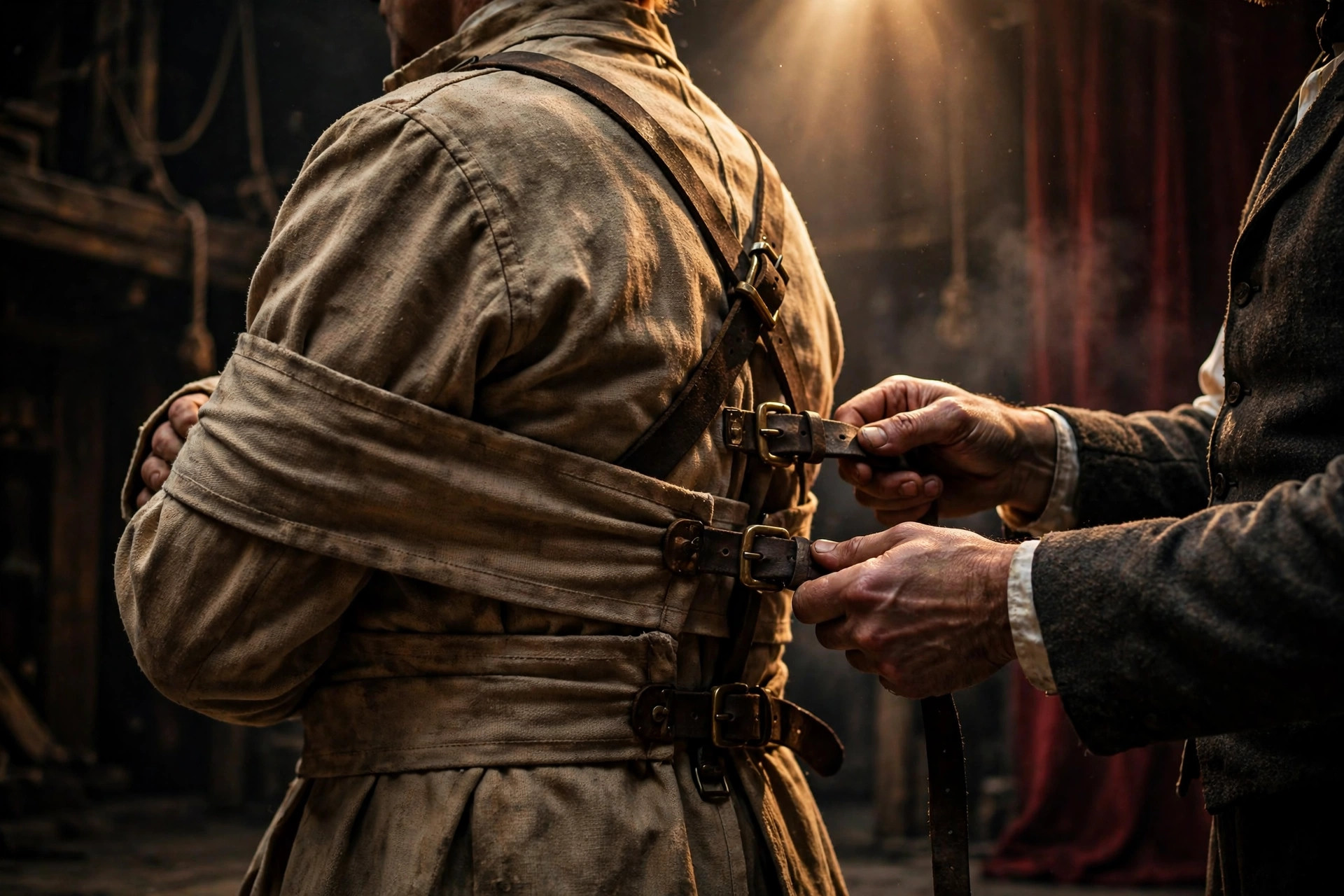
Then came the crucial move: as the jacket was buckled into place at the back, Houdini took one huge breath, expanding his chest to its full capacity. Once the jacket was locked down, he relaxed - and the combination of the secretly held slack and the deflating chest gave him a surprising amount of wiggle room in front. The straitjacket was designed to restrain someone who put it on honestly. Houdini never did.
Why Hanging Upside Down Actually Helped
Counterintuitively, being upside down was an advantage, not a handicap. Once suspended, Houdini used his strong right arm to violently force his weaker left elbow away from his body. This forced the hidden slack around his right shoulder, allowing him to pull his right arm up and over his head - and here gravity did the work for him, pulling the freed arm downward over the head rather than fighting him.
With both arms now in front of his body, the hardest part was over. He could undo the buckles and straps of the cuffs with his teeth, then work upward through the neck, top and bottom buckles until he could simply wiggle out of the jacket. And what about the legend that he dislocated his shoulders? According to Houdini's own account, dislocation was a last resort, not part of the method. He only attempted it when the slack technique failed - the normal escape needed nothing but flexibility, timing and nerve.
It is worth remembering the real danger: hanging by the ankles rushes blood to the head, and every second upside down made the concentration harder. The escape was a feat of physical conditioning as much as deception.
From 30 Minutes to 3 Minutes: The Training Nobody Talks About
The most impressive number attached to the straitjacket escape is not a secret at all - it is a measure of rehearsal. Over his career, Houdini reduced his escape time from around 30 minutes to roughly three. The mechanics never changed; the muscle memory did. Every pinch of slack, every shift of the elbow, was drilled until it could be executed calmly, upside down, in front of a screaming crowd - the same relentless polish that makes routines like the Cups and Balls look effortless.
A century after Houdini's final Halloween, his escapes still define the art form. For more on how the master of escape conquered the biggest stages of his era, read our look at Houdini's greatest illusions explained, including the Chinese Water Torture Cell he performed until his death.
Frequently Asked Questions
Did Houdini dislocate his shoulder to escape the straitjacket?
Not as a rule. Houdini wrote that dislocating a shoulder was a last resort he used only when his normal method failed. The standard escape relied on secretly acquired slack in the jacket, not joint manipulation - most performances used flexibility and timing alone.
How long did it take Houdini to escape a straitjacket?
At the peak of his career, roughly three minutes - down from around 30 minutes when he first developed the act. The improvement came entirely from practice: identical mechanics, executed faster and with complete calm while hanging upside down.
Why did Houdini perform the straitjacket escape hanging upside down?
Two reasons. First, spectacle: dangling from a crane above a street crowd let everyone see the escape with no curtains or screens, which made it an unbeatable advertisement for his evening shows. Second, physics: once his arms were freed, gravity helped him pull an arm over his head instead of fighting him.
How did Houdini come up with the straitjacket escape?
Through sibling rivalry. His younger brother Hardeen earned a standing ovation for escaping a straitjacket in full view of an audience, and Houdini - determined to outdo him - developed the hanging version that became one of his signature acts. He later published the underlying principles himself in his 1910 book Handcuff Escapes.
Is the straitjacket escape still performed today?
Yes. Escape artists worldwide still perform the hanging straitjacket escape using Houdini's principles, and the centenary of his death on 31 October 1926 has sparked a wave of tribute performances this Halloween - a reminder that a century later, his method still works exactly as he described it.
Julian Vance
Head of Sleight Analysis & Magic Historian
Former magic consultant for West End theatrical productions with over 18 years of sleight-of-hand performance experience.
Frequently Asked Questions
Continue Reading
How Does the Ambitious Card Trick Work? (Revealed)
Ever wondered how a signed card keeps rising to the top no matter where it is inserted? The full breakdown of the moves, angles and psychology.
10 Easy Card Tricks for Beginners (No Sleight of Hand)
You do not need years of knuckle-busting sleight of hand to astonish your friends. Ten self-working card tricks you can perform right away.
Loved This Breakdown? Learn to Perform It.
25 Self-Working Card Tricks Anyone Can Do - the ebook that turns you from spectator to magician. No sleight of hand needed.
Get the Ebook - $12