
How Does Sawing a Woman in Half Work? (Revealed)
The box, the hidden table and the two-assistant secret behind stage magic’s most famous illusion, fully explained.
For over a century, audiences have gasped at the same impossible picture: a woman in a wooden box, a saw biting through the middle of it, and the two halves pulled apart — head and hands on one side, feet on the other. So how does sawing a woman in half work? Nobody is cut. The trick works through cleverly built furniture, hidden space, and one piece of casting: the head and feet do not always belong to the same person.
Sawing a Woman in Half: What the Audience Sees
Every version follows the same dramatic script. An assistant climbs into a long wooden box resting on a table. Her head and hands emerge from holes at one end, and her feet from the other. Sometimes her wrists and ankles are tied with ropes, and audience volunteers are invited to hold them.
The magician then saws through the middle of the box. Metal divider blades are slid into the cut, the two halves are pulled apart, and then everything is pushed back together. The box is opened, and the assistant steps out whole and smiling. It is the defining image of stage magic, in the same grand-illusion tradition as the cups and balls routine.
How Do Magicians Saw Someone in Half? The Two-Assistant Secret
How do magicians saw someone in half without anyone being harmed? The classic box version uses two assistants, not one. Before the box is even brought on stage, a second assistant is already hidden inside the table beneath it, whose underside angles downward to create a concealed space despite looking thin from the front.
As the visible assistant climbs into the box, the hidden assistant slips up through a trap in the table and into the lower half of the box, poking her feet out of the far end. The first assistant draws her knees up to her chin; the second curls up with her head bent forward between her knees. That leaves an empty gap in the middle — exactly where the saw will travel.
The Box, the Table and the Divider Blades
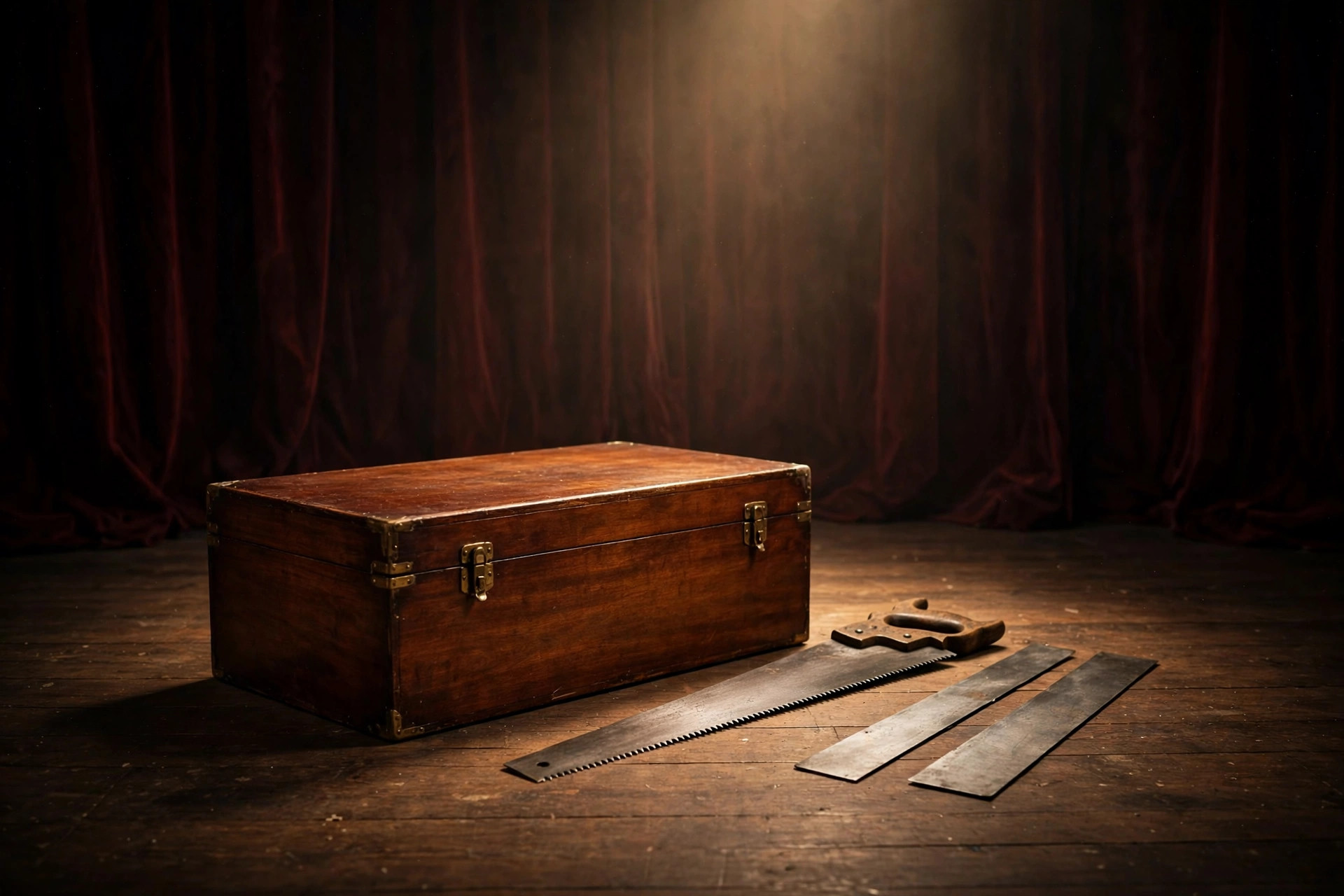
The furniture does most of the work. The box is deeper and wider than it appears from the audience, and the table is a cabinet in disguise. The audience views the box from the front, so they never see its true depth, and the table legs hide the hollow space underneath.
The divider blades serve two purposes. Practically, they cover the cut ends so the audience cannot peer inside when the halves separate. Psychologically, they sell the cut: sliding cold steel into the box makes the division feel final. Some versions skip the saw entirely and use only the blades. The same principle — equipment designed around what the audience cannot see — powers the linking rings illusion.
Who Invented Sawing a Woman in Half? Selbit, Goldin and the 1921 Rivalry
Who invented sawing a woman in half? The English magician P. T. Selbit is generally recognised as the first to perform it on a public stage, at the Finsbury Park Empire in London on 17 January 1921. In Selbit’s version, the assistant was secured in a coffin-like box with ropes around her wrists, ankles and neck, and sawn through with a large hand saw.
The American illusionist Horace Goldin soon followed with his own box sawing, and was often wrongly credited as the originator. Goldin’s version — the horizontal box, the head and feet protruding, the dividers, the halves pulled apart — became the template most later performers copied. For the wider story of stage spectacle, read our guide to the greatest illusions in magic history.
Is Sawing a Woman in Half Real? Modern Versions and the Zig Zag Girl
Is sawing a woman in half real? No — no performer is ever cut, and the saw never comes near a body. Modern versions add twists: buzzsaws instead of hand saws, transparent boxes, and versions where the magician himself is sawn in half. The most famous descendant is the zig zag girl illusion, in which the assistant’s middle section appears to slide sideways out of alignment with her head and legs.
The reason the original still works, more than a century on, is that it attacks the audience’s logic rather than their eyesight. You see the head move, the feet wiggle, and the saw go through. Your brain joins those three facts into one person — and one person cannot survive being sawn in half. Once you know the head and the feet can belong to two different people, the impossible picture collapses into carpentry. The same showmanship built the career of the escape artist in our account of how Houdini escaped the straitjacket.
Frequently Asked Questions
Is sawing a woman in half real?
No. The assistant is never cut. The saw passes through an empty section of the box, and the head and feet can belong to two different assistants.
How do magicians saw someone in half without hurting the assistant?
The classic method keeps every body part away from the blade’s path. One assistant curls up in the top half, a second assistant hidden in the table provides the feet, and the middle is left empty for the saw.
Who invented sawing a woman in half?
P. T. Selbit first performed it publicly at the Finsbury Park Empire in London on 17 January 1921. Horace Goldin’s popular version followed and became the template most magicians still use.
What is the zig zag girl trick?
The zig zag girl is a later variation in which the assistant’s midsection appears to slide sideways out of line with her head and legs. Like the sawing illusion, it relies on hidden space inside the cabinet.
Why do magicians use divider blades in the sawing trick?
The blades cover the cut ends so the audience cannot see inside when the halves are pulled apart, and they make the division feel final. In blade-only versions, they replace the saw altogether.
Julian Vance
Head of Sleight Analysis & Magic Historian
Former magic consultant for West End theatrical productions with over 18 years of sleight-of-hand performance experience.
Continue Reading
How Does the Ambitious Card Trick Work? (Revealed)
Ever wondered how a signed card keeps rising to the top no matter where it is inserted? The full breakdown of the moves, angles and psychology.
10 Easy Card Tricks for Beginners (No Sleight of Hand)
You do not need years of knuckle-busting sleight of hand to astonish your friends. Ten self-working card tricks you can perform right away.
Loved This Breakdown? Learn to Perform It.
25 Self-Working Card Tricks Anyone Can Do - the ebook that turns you from spectator to magician. No sleight of hand needed.
Get the Ebook - $12