
How Does Sword Swallowing Work? (The Real Secret)
No retractable blade, no hidden tube: the real anatomy, training and danger behind the act.
Sword swallowing is real. When a trained performer slides a long steel blade down his throat on stage, there is no retractable trick sword and no hidden tube waiting inside his body. The blade genuinely travels down the throat, through the oesophagus, and into the stomach. So how does sword swallowing work without killing the performer? The answer is not one secret move, but years of training that teaches the body to switch off reflexes most of us cannot control on command.
Is Sword Swallowing Real or Fake?
This is the first question every audience asks, and the honest answer surprises most people: professional sword swallowing is not an illusion at all. Joke-shop retractable swords exist, but no serious performer uses one, because the whole point of the act is that the blade is solid, straight, and visibly real. X-ray images of performers mid-swallow show the blade running down the chest, and a medical study published in the British Medical Journal in 2006 examined 48 professional swallowers.
That is why sword swallowing sits apart from most stage magic. A trick like the zig-zag girl illusion fools the eye with a hidden compartment; sword swallowing fools nothing. The blade is genuine, the danger is genuine, and only control over his own anatomy protects the performer, as with the feat in our guide to how the bullet catch trick works.
How Do Sword Swallowers Not Die? The Anatomy of the Act
The human throat is not built as a straight tube. Food normally travels down in a wave of muscle contractions called peristalsis, while the gag reflex, the epiglottis guarding the windpipe, and two sphincter muscles stand guard along the way. A sword swallower has to reverse almost all of that: suppress the gag reflex completely, flip the epiglottis out of the way so the blade enters the oesophagus rather than the windpipe, and keep the passage still and open.
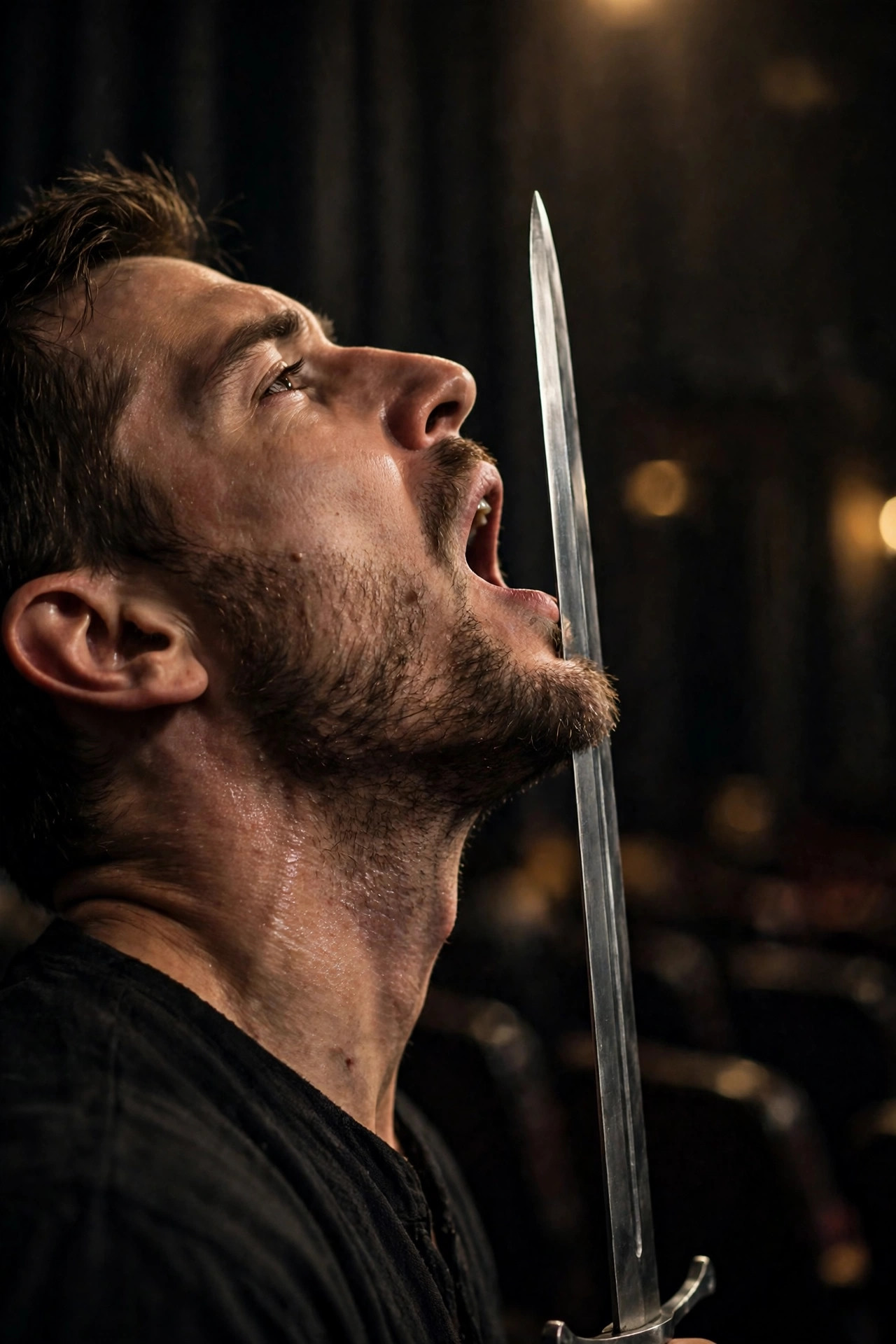
Posture does the next part of the work. By stretching the neck and tilting the head back, the performer straightens the natural bend between mouth and oesophagus into a single line. The blade slides down the chest, past the voice box, nudging the heart slightly aside as it passes behind it. Finally, the lower oesophageal sphincter, the muscle that normally keeps stomach contents from creeping upward, must be relaxed on command so the tip can enter the stomach. Swallowing food uses muscle contractions; swallowing a sword requires the absence of them.
The blade must be straight, because the oesophagus will not accept a curve, and it must move in one gentle, smooth motion. Any jerking, coughing, or loss of concentration at the wrong second can drive the tip into the wall of the throat.
How Long Does It Take to Learn Sword Swallowing?
Learning to swallow a sword takes most performers between three and seven years, with several more years to master it properly. Dan Meyer, president of the Sword Swallowers Association International, has described needing three years of practice before he could perform reliably. Training is deliberately gradual: performers begin by dulling the gag reflex, then progress through spoons, paint brushes, knitting needles, and plastic tubes, and only much later to a bent wire coat hanger and then a real blade.
The British Medical Journal study found that most swallowers practised daily over months or years before their first public performance. That is why almost no professional will teach a beginner: the skill cannot be learned from a video, and a single unguided attempt can cause a perforated throat. Unlike a close-up routine such as the French drop coin vanish, which anyone can practise safely at a kitchen table, sword swallowing has no safe rehearsal version.
Sword Swallowing Dangers and Side Effects
The dangers are not theoretical. The 2006 study recorded that nearly every professional swallower surveyed had suffered at least one serious injury, and at least 29 sword swallowers are known to have died from swallowing-related injuries over the past 150 years. Perforation of the throat or oesophagus is the most feared outcome, requiring emergency surgery. Far more common is "sword throat", a persistent sore throat and chest pain that follows performances, along with acid damage to the teeth.
Injuries cluster around exactly the moments you would expect: swallowing multiple swords at once, using an unusual blade, or losing focus mid-swallow. One performer in the study punctured his stomach while swallowing five swords and was distracted at the critical moment. The lesson is strict and simple: one sword, full concentration, no distractions. It is the same discipline behind every great escape, including the one described in our guide to how Houdini escaped the straitjacket: the drama on stage is real, but the risk is managed, never eliminated.
So how does sword swallowing work, in one sentence? A straight blade, a straightened throat, reflexes trained into silence over years, and a performer calm enough to keep them silent for the ten seconds that matter. It is a 4,000-year-old art that began with holy men in India around 2000 BC. Do not try it. Admire it, understand it, and leave the blade to the handful of people on Earth who have spent years learning to live with it.
Frequently Asked Questions
Is sword swallowing real?
Yes. The blade genuinely goes down the oesophagus into the stomach, confirmed by X-ray imaging and a 2006 British Medical Journal study.
Do sword swallowers use fake or retractable swords?
No. Retractable swords are joke-shop props; professionals use solid, straight steel blades.
How long does it take to learn sword swallowing?
Most need three to seven years of daily, gradual practice, and several more years to master it.
Is sword swallowing dangerous?
Extremely. Perforation, chest pain, and "sword throat" are documented risks, and at least 29 swallowers have died from related injuries.
Can anyone learn to swallow a sword?
Anatomy is similar, but professionals advise against trying: one unguided attempt can cause a life-threatening injury.
Julian Vance
Head of Sleight Analysis & Magic Historian
Former magic consultant for West End theatrical productions with over 18 years of sleight-of-hand performance experience.
Frequently Asked Questions
Continue Reading
How Does the Ambitious Card Trick Work? (Revealed)
Ever wondered how a signed card keeps rising to the top no matter where it is inserted? The full breakdown of the moves, angles and psychology.
10 Easy Card Tricks for Beginners (No Sleight of Hand)
You do not need years of knuckle-busting sleight of hand to astonish your friends. Ten self-working card tricks you can perform right away.
Loved This Breakdown? Learn to Perform It.
25 Self-Working Card Tricks Anyone Can Do - the ebook that turns you from spectator to magician. No sleight of hand needed.
Get the Ebook - $12