
How Does the Zig Zag Girl Illusion Work?
Blades slide in, the middle slides sideways — and she steps out whole. The 1965 cabinet secret, explained.
A woman steps into a tall, narrow wooden cabinet. Her face appears through an opening at the top, one hand through a gap in the middle, and a bare foot at the bottom. Two large metal blades slide horizontally through the cabinet, dividing it — and apparently her — into three sections. Then the magician pushes the middle section sideways, and the zig zag girl illusion is complete: her body appears bent into an impossible zig-zag, torso and legs no longer aligned. A spectator is invited to open a small door in the displaced middle and touch what is inside. Moments later the sections slide back, the blades come out, and she steps out completely unharmed. How does the zig zag girl illusion work?
The Secret: A Cabinet Bigger Than It Looks
The zig zag girl trick revealed in full comes down to two facts the audience never suspects: the cabinet is wider than it appears, and the assistant, not the magician, is the star of the method. The cabinet’s sides are painted with wide black strips that make it look far narrower than it really is. All that black space is usable interior. Inside, the assistant folds herself into a compact, contorted position that fills the hidden width — a tight fit that demands flexibility, strength, and absolute calm.
When the middle section slides sideways, the assistant’s body does not move with it in the way the audience assumes. Her head stays in the top section, her foot stays in the bottom section, and her midsection occupies the sliding middle — but because the cabinet is deeper and wider than it looks, she has room to bend and shift within it. The visible face, hand, and foot are real, and they are exactly where they should be. Everything between them is a masterclass in misread space.
This is why the illusion is traditionally performed with a female assistant of smaller build: the method depends on fitting a human body into a space the audience believes is too small for one. The magician outside is largely a presenter; the assistant inside does the real work, holding an uncomfortable position with a serene expression while a stranger opens a door inches from her face.
Why the Blades Never Touch Her
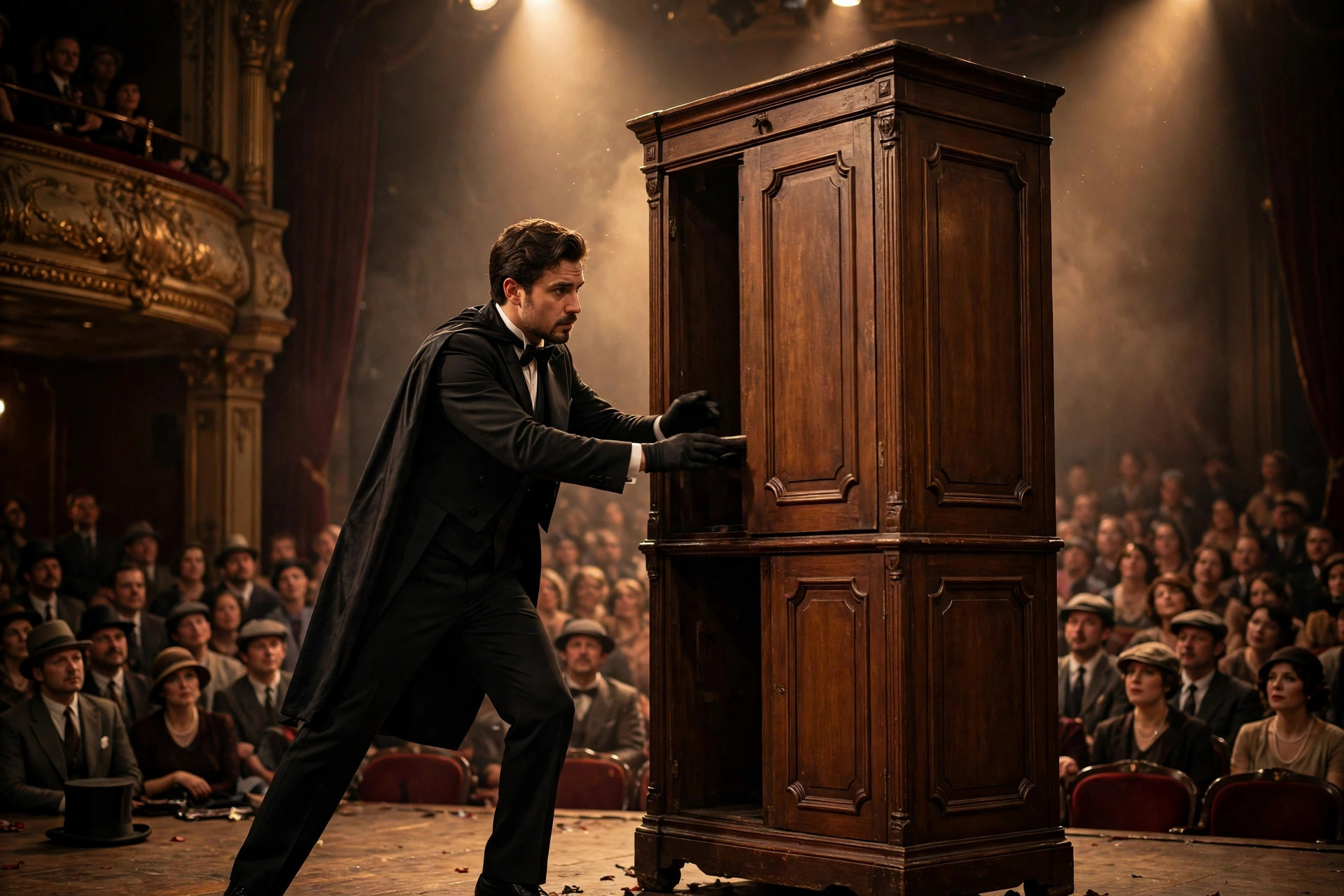
The blades look terrifying, but they are precision props. When a blade slides in from the right side of the cabinet, its handle fills the full width of the box on the outside, which convinces the eye that the blade spans the whole interior. In reality, the blade inside only reaches partway across — exactly into the space the assistant is not occupying. The handles do the lying; the blades do the framing.
The small inspection door in the middle section is the illusion’s boldest move. Opening it should destroy the trick — instead, it strengthens it. The spectator sees and touches a real midsection inside the displaced box, which proves to their brain that the body really has been divided. What they do not realise is that the interior they are examining is only the portion the assistant has chosen to show them, arranged within the cabinet’s hidden extra width.
Unlike many stage illusions, the Zig Zag does not depend on distance, darkness, or a fixed viewing angle. It can be performed surrounded by spectators and still hold up, which is why it became one of the most copied illusions in magic history after Robert Harbin debuted it in October 1965 at a Magic Circle banquet in London.
Robert Harbin and the Invention of the Zig Zag
The Robert Harbin zig zag girl was a deliberate break from the sawing illusions that came before it. Earlier divide-a-woman effects relied on gore, boxes, and shock. Harbin, a veteran British illusion designer, wanted an elegant puzzle instead: no blood, no screaming, just a calm woman, a plain cabinet, and a shape the human body should not be able to make. He refined the idea from his earlier “Little by Little” illusion, and the Zig Zag’s debut on television’s International Showtime spread it around the world within months.
Harbin’s original cabinet is now on display in the Magic Circle museum in London, a testament to how highly magicians rate the design. Modern variations keep the same principles and push them further: the “head out” version lets the assistant’s whole head project from the top of the cabinet, and the five-way zig zag divides the cabinet into five sections instead of three.
Zig Zag Girl vs Sawing a Woman in Half
Audiences often ask whether the zig zag girl secret explained here is the same as the sawing illusion. The two share a theme — a divided assistant who emerges whole — but their methods are opposites. Sawing illusions hide the assistant’s real body in a table or box while a false body takes the blade. The Zig Zag hides nothing about the body itself; it hides space. The assistant is genuinely inside the cabinet, genuinely contorted, and genuinely on display.
That honesty is the Zig Zag’s strength. Because the face, hand, and foot are real and continuously visible, the audience never suspects a substitution — and because the cabinet’s true dimensions are disguised by paint and proportion, they never suspect the space either. Two small lies, one about width and one about who does the work, carry the entire illusion.
For the full stage-illusion context, see our zig zag girl stage illusion breakdown, or compare it with how sawing a woman in half works. For a close-up levitation built on the same misdirection of space, read how the floating card trick works, and for the greatest stage effects ever devised, see famous magicians’ greatest illusions explained.
Frequently Asked Questions
Is the assistant really cut into three pieces in the zig zag girl trick?
No. She is never cut at all. She contorts inside a cabinet that is wider than it looks, while the blades only reach into space she is not occupying.
Who invented the zig zag girl illusion?
British magician Robert Harbin, who debuted it in October 1965 at a Magic Circle banquet in London. His original cabinet is displayed in the Magic Circle museum.
Can the audience really examine the middle section?
Yes, and that is the point. A spectator may open the middle door and touch the assistant inside. The inspection strengthens the illusion because the examined portion is genuinely her midsection, arranged within the cabinet’s hidden width.
Why is the zig zag girl usually a woman?
The method requires fitting into a very tight hidden space, so it is generally performed with a smaller-built assistant. The role also demands the flexibility and composure to hold a contorted position calmly.
What is the five-way zig zag?
A variation that divides the cabinet into five sections instead of three, using the same hidden-space principles with an even more extreme apparent displacement.
Julian Vance
Head of Sleight Analysis & Magic Historian
Former magic consultant for West End theatrical productions with over 18 years of sleight-of-hand performance experience.
Frequently Asked Questions
Continue Reading
How Does the Ambitious Card Trick Work? (Revealed)
Ever wondered how a signed card keeps rising to the top no matter where it is inserted? The full breakdown of the moves, angles and psychology.
10 Easy Card Tricks for Beginners (No Sleight of Hand)
You do not need years of knuckle-busting sleight of hand to astonish your friends. Ten self-working card tricks you can perform right away.
Loved This Breakdown? Learn to Perform It.
25 Self-Working Card Tricks Anyone Can Do - the ebook that turns you from spectator to magician. No sleight of hand needed.
Get the Ebook - $12